Congratulations, new parents! You’ve prepared yourselves, experienced the birth of your baby, and it’s time to go home and start your lives as a family. Bringing your newborn home is exciting, but we understand it can also feel overwhelming. During your baby’s first week at home, you’ll likely have questions about feeding, sleeping, diapers, weight loss, umbilical cord care, and what’s considered normal. In this guide, our pediatricians explain what to expect during the first week with your newborn, signs your baby is healthy, warning signs to watch for, and when to call us.
What To Have At Home For Your First Week
- Diapers of varying sizes
- Diaper wipes
- Diaper rash cream, like Desitin Triple Paste, etc.
- 1% hydrocortisone for inflammation and
- Neosporin
- Thick moisturizer for baby’s skin, such as Aquaphor or Vaseline
- Baby shampoo
- Baby bath soap
- Baby lotion
- Saline mist for clearing nasal congestion
- Boogie Wipes which are gentle to wipe a baby’s nose and prevent skin irritation
- Vitamin D drops (if exclusively nursing)
- Natural Tears, to help gently rinse out eyes and prevent them from getting crusty if they become mucousy
- Infants Tylenol (acetaminophen) to be used ONLY under the direction of your pediatrician
- Infant thermometer – we prefer the digital readers with rectal probes
- Infant moisturizer for body and face
- Alcohol pads pre-packaged (for gentle umbilical care)
- Nail file (buffer version for the first years)
- Bottle sets
- Bathtub with sling
Feeding Your Newborn During the First Week
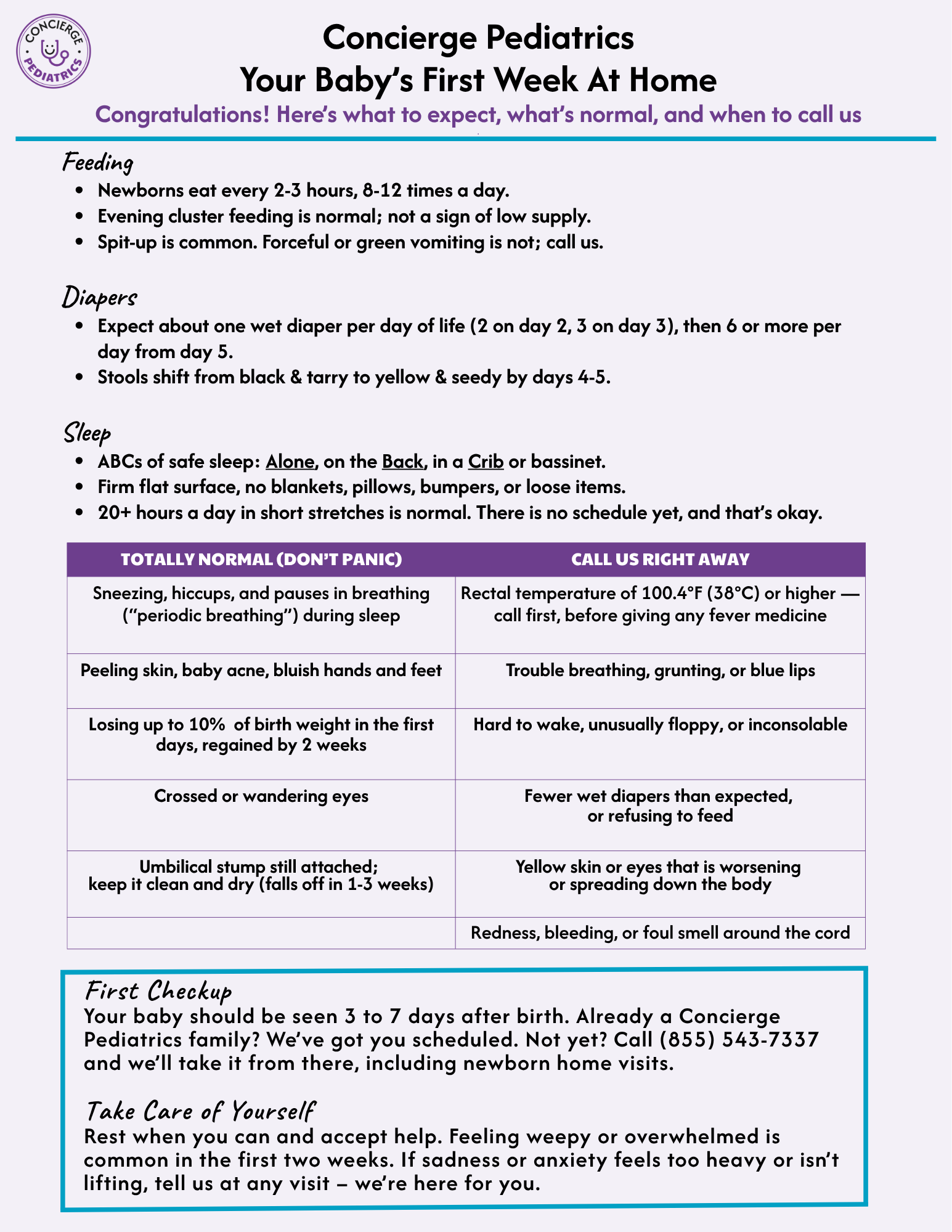
- Newborns eat every 2-3 hours, 8-12 times a day.
- Evening cluster feeding is normal; not a sign of low supply.
- Spit-up is common. Forceful or green vomiting is not; call us.
Wet Diapers and Newborn Poop: What’s Normal?
- Expect about one wet diaper per day of life (2 on day 2, 3 on day 3), then 6 or more per day from day 5.
- Their stools (poop) will start off looking black and tarry before switching over to looking yellow & seedy by days 4-5.
Safe Sleep For Newborns
- Remember the ABCs of safe sleep:
- Alone
- on their Back
- in a Crib or bassinet.
- Put baby on a firm flat surface, no blankets, pillows, bumpers, or loose items.
- It is recommended for baby to sleep in the same room as a parent or caregiver, but baby should have their own sleeping space to keep them most safe.
- Sleeping for 20+ hours a day in short stretches is normal. There is no schedule yet, and that’s okay.
What’s Normal During Your Baby’s First Week?
Do their eyes look a little funny? Why does the top of their head look like it has dandruff already? we know you’ve got questions. Let’s unpack some common scenarios to alleviate some of those fears and highlight any need for quick medical attention.
Normal Newborn Behaviors – Don’t Panic!
- Sneezing, hiccups, and pauses in breathing (“periodic breathing”) during sleep
- Peeling skin, baby acne, bluish hands and feet
- Losing up to 10% of birth weight in the first days, regained by 2 weeks
- Crossed or wandering eyes
- Umbilical stump still attached – keep it clean and dry
- This will fall off naturally in 1-3 weeks of birth
When To Call Your Pediatrician
If you spy any of these things, give your pediatrician a call right away for guidance. These things could signal the need for immediate medical intervention, and you should be in touch with your medical team to help you through next steps.
- Rectal temperature of 100.4°F (38°C) or higher — call first, before giving any fever medicine
- Trouble breathing, grunting, or blue lips
- Grunting and squeaking can be normal, but signals of difficulty breathing and any facial blueness can be an emergency
- Hard to wake, unusually floppy, or inconsolable
- Fewer wet diapers than expected, or refusing to feed
- Yellow skin or eyes that is worsening or spreading down the body
- Redness, bleeding, or foul smell around the umbilical cord
Remember that you should always be able to call your pediatrician in any scenario that gives you concern. We are here to help walk you through any uncertainty, so don’t hesitate to reach out if anything feels off. If you ever believe your baby is experiencing an urgent, life threatening emergency, call 911.
Your Baby’s First Checkup With The Pediatrician
Your baby should be seen 3 to 7 days after birth. At Concierge Pediatrics, here’s what we cover for our members during that first visit:
- Full physical exam of baby, head to toe
- Mother’s health history
- Pregnancy history
- Review of what was done at the hospital during birth
- Discussion of
- feeding expectations
- bowel movements & wet diapers
- Sleep expectations
- Gastrointestinal (GI) issues
- Developmental milestones
- Fever guidance
- What to look out for during the first 2 months of life
You will be visiting your pediatrician about once a month after baby is born, so you will have lots of opportunity for questions and review with your pediatrician. We’re always here to partner with you.
Already a Concierge Pediatrics family? We’ve got you scheduled. Not yet? Call (855) 543-7337 and we’ll take it from there, including the option for newborn home visits.
Remember How Important it is to Take Care of Yourself
Rest when you can and accept help. Feeling weepy or overwhelmed is common in the first two weeks. If sadness or anxiety feels too heavy or isn’t lifting, tell us at any visit – we’re here for you.